
Technology adoption
You reach for this when you are about to introduce new software, or when you already did and adoption stalled: the tool was bought, rolled out, trained on – and then quietly worked around.
Most organizations diagnose low adoption rates as resistance to change. The famous hype cycle even tells everyone “this is fine!”, immunizing tech vendors from any responsibility for slow uptake. It is not fine: low adoption is almost never “resistance.” Most of the time it’s that the tool was built for the person who buys the tech, who consumes the dashboard, not for the person who has to make it actually work for eight hours a day.
What we look at
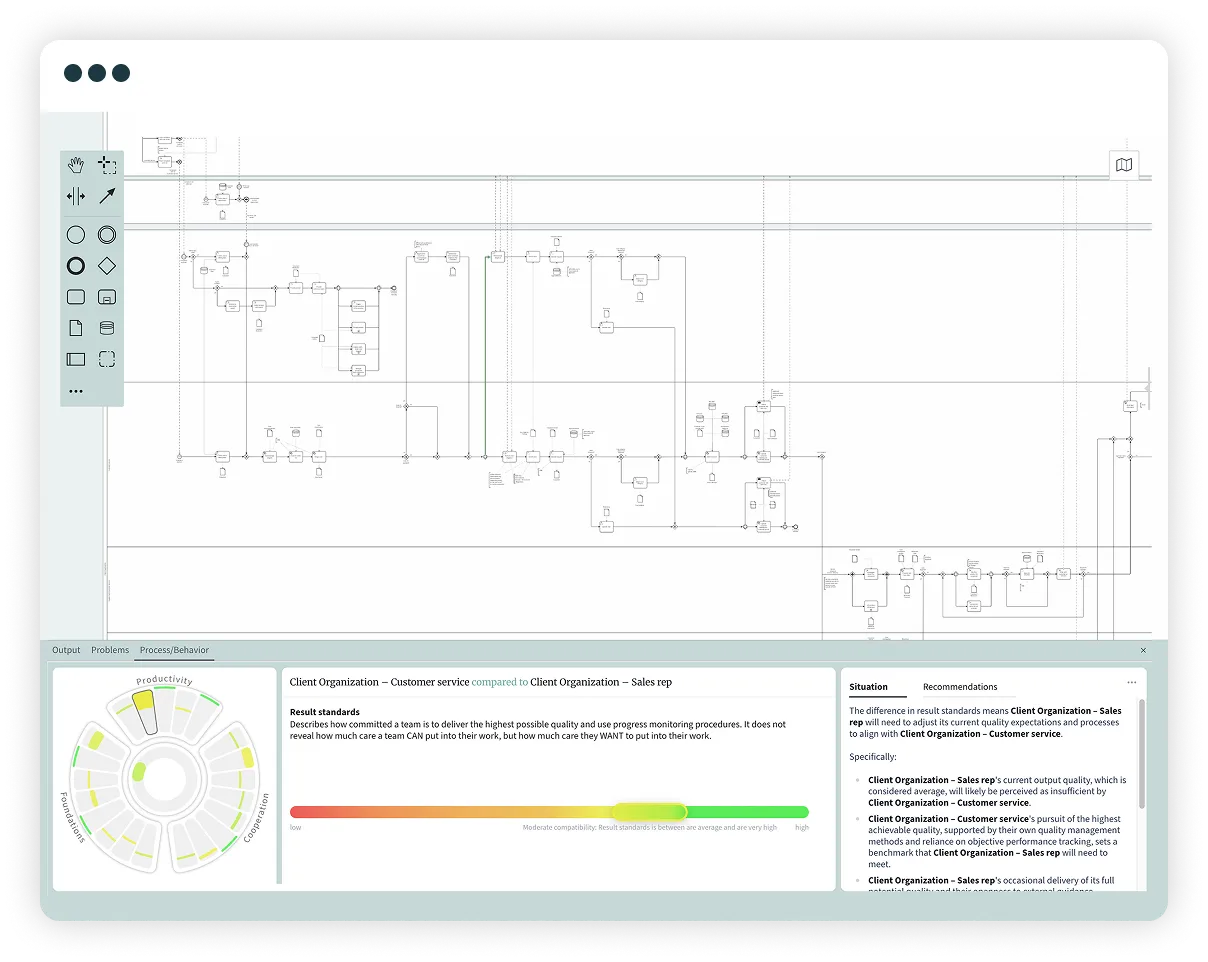
We measure each team’s capacity to absorb new structures and routines. This has both a behavioral component, where we determine each team’s individual properties as a group, and a structural component, where we determine how the changed workflows impact the processes that they run.
How we solve this
A team operating at high cognitive strain will not absorb, regardless of training or energizing all-hands meetings. A team with low trust in leadership will treat any new tool as the latest in a series of impositions. A team that thrives on control will tend to work around automation.
We know how to uncover this and build interventions that solve it. Team by team, not organization-wide.
Outcome
What you get is adoption that holds. Because it was engineered into how each team actually works rather than announced at a kickoff. You get live numbers to steer while it happens. And you don’t waste any more time on persuasion that was never going to work.
In the first six months of working with your recommendations, CRM use has increased from 20% to a little less than 60%.
We have achieved something that we have not been able to do in the past 10 years. Feel free to share that – a tripling of usage in six months!
Head of Commercial Excellence Europe, BASF Agricultural Solutions
This is change management done in the right order: measure first, then act. The usual order – roll out, train, wait, diagnose – is how organizations end up replacing a system nobody uses with a newer system nobody uses.